Summary of case involving the role of CEQA in assessing impact of global warming on project: Ballona v. Los Angeles (Nov. 9, 2011)

Ballona Wetlands Land Trust v. City of Los Angeles ((November 9, 2011)

Cal. Court of Appeal (Second District, Division 3) B231965

Interesting case involving the role of California Environmental Quality Act (CEQA) in assessing potential flooding of proposed project due to global warming sea level rise:

SUMMARY OF KEY FACTS:

Ballona Wetlands Lands Trust and other environmental organizations challenged a revised EIR certified by the City of Los Angeles concerning a proposed mixed-use development. The revised EIR included a new section about possible impacts of climate change, addressing the project’s projected contributions to greenhouse gases and noting the potential for sea level rise that could inundate coastal areas.

Of interest here is that Ballona submitted comments and complained the revised EIR had failed to address the impacts of a sea level rise on the project. The City engineer responded that the flood risks were overstated. He concluded the project was two miles from the sea, separated by higher topography from the sea, and that the sea level rise projected by the Intergovernmental Panel on Climate Change was lower and more reliable than the extreme worst-case scenario that Ballona relied upon from a report prepared by the California Climate Change Center.

SUMMARY OF COURT RULING:

The Court of Appeal held that CEQA requires the EIR identify the significant effects of a project on the environment, not the other way around. While the Court agreed an EIR should identify environmental effects of attracting development and people to an area, it disagreed that the EIR has to identify the environmental effects on a project and people in a particular environmental setting.  The Court disagreed with CEQA Guidelines section 15126.2, which say an EIR should analyze how a project that brings development and people into risky areas such as an active earthquake or flood zone. The Court found such Guidelines inconsistent with the requirements of CEQA and thus invalid.

Prepared by John Reaves

Posted in Appellate Case Summaries, Current News | Comments Off on Summary of case involving the role of CEQA in assessing impact of global warming on project: Ballona v. Los Angeles (Nov. 9, 2011)

Rep. Pete Stark introduces H.B. 3242, Save Our Climate Act

California Democratic House member, Pete Stark, has introduced a bill that seeks to place a price on carbon — $10 added each year per ton of carbon product that will be burned and emit carbon dioxide. That fee is applied until CO2 drops to 20% of the 1990 level. An estimated $2.6 trillion would be raised in a decade, of which $490 million would be applied to deficit reduction. There are border adjustments to keep American businesses competitive internationally. We now need to see Republicans jump in to support this bill and get our country back to prosperity and cleaner air.

Posted in Current News, Reaves' Articles | Comments Off on Rep. Pete Stark introduces H.B. 3242, Save Our Climate Act

The scientific finding that settles the climate-change debate. Washington Post Editorial

By , Published: October 24

For the clueless or cynical diehards who deny global warming, it’s getting awfully cold out there.

The latest icy blast of reality comes from an eminent scientist whom the climate-change skeptics once lauded as one of their own. Richard Muller, a respected physicist at the University of California, Berkeley, used to dismiss alarmist climate research as being “polluted by political and activist frenzy.” Frustrated at what he considered shoddy science, Muller launched his own comprehensive study to set the record straight. Instead, the record set him straight.

“Global warming is real,” Muller wrote last week in The Wall Street Journal.

Rick Perry, Herman Cain, Michele Bachmann and the rest of the neo-Luddites who are turning the GOP into the anti-science party should pay attention.

“When we began our study, we felt that skeptics had raised legitimate issues, and we didn’t know what we’d find,” Muller wrote. “Our results turned out to be close to those published by prior groups. We think that means that those groups had truly been careful in their work, despite their inability to convince some skeptics of that.”

In other words, the deniers’ claims about the alleged sloppiness or fraudulence of climate science are wrong. Muller’s team, theBerkeley Earth Surface Temperature project, rigorously explored the specific objections raised by skeptics — and found them groundless.

Muller and his fellow researchers examined an enormous data set of observed temperatures from monitoring stations around the world and concluded that the average land temperature has risen 1 degree Celsius — or about 1.8 degrees Fahrenheit — since the mid-1950s.

This agrees with the increase estimated by the United Nations-sponsoredIntergovernmental Panel on Climate Change. Muller’s figures also conform with the estimates of those British and American researchers whose catty e-mails were the basis for the alleged “Climategate” scandal, which was never a scandal in the first place.

The Berkeley group’s research even confirms the infamous “hockey stick” graph — showing a sharp recent temperature rise — that Muller once snarkily called “the poster child of the global warming community.” Muller’s new graph isn’t just similar, it’s identical.

Muller found that skeptics are wrong when they claim that a “heat island” effect from urbanization is skewing average temperature readings; monitoring instruments in rural areas show rapid warming, too. He found that skeptics are wrong to base their arguments on the fact that records from some sites seem to indicate a cooling trend, since records from at least twice as many sites clearly indicate warming. And he found that skeptics are wrong to accuse climate scientists of cherry-picking the data, since the readings that are often omitted — because they are judged unreliable — show the same warming trend.

Muller and his colleagues examined five times as many temperature readings as did other researchers — a total of 1.6 billion records — and now have put that merged database online. The results have not yet been subjected to peer review, so technically they are still preliminary. But Muller’s plain-spoken admonition that “you should not be a skeptic, at least not any longer” has reduced many deniers to incoherent grumbling or stunned silence.

Not so, I predict, with the blowhards such as Perry, Cain and Bachmann, who, out of ignorance or perceived self-interest, are willing to play politics with the Earth’s future. They may concede that warming is taking place, but they call it a natural phenomenon and deny that human activity is the cause.

It is true that Muller made no attempt to ascertain “how much of the warming is due to humans.” Still, the Berkeley group’s work should help lead all but the dimmest policymakers to the overwhelmingly probable answer.

We know that the rise in temperatures over the past five decades is abrupt and very large. We know it is consistent with models developed by other climate researchers that posit greenhouse gas emissions — the burning of fossil fuels by humans — as the cause. And now we know, thanks to Muller, that those other scientists have been both careful and honorable in their work.

Nobody’s fudging the numbers. Nobody’s manipulating data to win research grants, as Perry claims, or making an undue fuss over a “naturally occurring” warm-up, as Bachmann alleges. Contrary to what Cain says, the science is real.

It is the know-nothing politicians — not scientists — who are committing an unforgivable fraud.

eugenerobinson@washpost.com

Posted in Current News | Comments Off on The scientific finding that settles the climate-change debate. Washington Post Editorial

Military lauded for green energy support – Letter to the Editor SD U-T (10-17-11)

I’d like to thank these senior military officers who authored “Why we must support clean energy: national security” (Opinion, Oct. 13) for their insight and clear direction. With the military urging prompt action to combat climate change and redouble our efforts to transition to clean energy, it is time our elected officials listened – and listened carefully.

Sadly, it seems to have become popular among some Republicans, including most of the presidential candidates, to speak with angry and dismissive rhetoric these days about climate change, regulation of greenhouse gases or the need to press forward now with clean energy. You have to hope the wisdom shared does not continue to fall on deaf and stubbornly uninformed ears.

When will the rational voices in both parties speak up? We need a price on carbon. — John H. Reaves, San Diego

Posted in Reaves' Opinions and Letters to the Editor | Comments Off on Military lauded for green energy support – Letter to the Editor SD U-T (10-17-11)

Ninth Circuit affirms dismissal of toxic tort plaintiffs who failed to make prima facie case of exposure and causation.

Avila v. Willits Environmental Remediation Trust, 633 F.3d 828 (9th Cir. 2011), cert. denied (2011 U.S. LEXIS 5526, Oct. 3, 2011)

The Ninth Circuit dismissed portions of a mass toxic tort case by affirming the discretion of the district court to require plaintiffs to make a prima facie case showing both exposure to toxins and causation of the claimed damages.

Some of the plaintiffs had been dismissed because they failed to respond to a discovery questionnaire approved by the court. Others were dismissed for failing to show that those plaintiffs who did not live close to the Avila contaminated site, or only lived nearby for short periods of time, a prima facie case of exposure and causation with expert declarations in support.


Posted in Appellate Case Summaries | Comments Off on Ninth Circuit affirms dismissal of toxic tort plaintiffs who failed to make prima facie case of exposure and causation.

Summary of case showing how a homeowners’ association’s CC&Rs can conflict with an owner’s solar energy plans

Teroso Del Valle Homeowners Assoc. v. Griffin (October 3, 2011)

Cal. Court of Appeal (Second District, Division 2) B222531

Interesting case showing how a homeowners’ association’s CC&Rs can conflict with an owner’s solar energy plans:

SUMMARY OF KEY FACTS:

After a ten-day trial, a jury found in favor of Tesoro Homeowners’ Association (HOA)’s claims that homeowners, the Griffins, installed a solar system in contravention of the HOA Conditions, Covenants, and Restrictions (CC&Rs). The Court of Appeal affirmed the judgment.

The CC&Rs required an owner to obtain approval from the Architectural Control Committee (ACC) before making any improvements to their property. The CC&Rs also prohibited structures from being placed on slopes that could cause drainage problems or other damage. The HOA also had Design Guidelines (DG) which mirrored Civil Code section 714 which allows CC&Rs to impose reasonable restrictions on photovoltaic systems that do not significantly increase costs (more than $2000), decrease efficiencies or performance (by 20%), or that allow for a comparable, alternative system. Finally, the CC&Rs allowed the HOA to consider aesthetic impacts of a solar system.

The Griffins requested permission to install a solar system on the slope next to their home, later modifying plans by having part of the system installed on their roof in addition to the slope. The HOA denied the system on the slope out of concern for drainage problems and line-of-sight issues. The Griffins started to build the project any way, starting with the roof, and then removed landscaping on the slope and poured a concrete foundation for pylons. At that point, they finally agreed to the HOA demands to suspend construction but refused to return the slope to its original condition. The Griffins disagreed with ongoing HOA restrictions on the slope and ultimately thumbed their noses and completed the entire $97,000 project.

The HOA sued the Griffins for breach of the CC&Rs regarding the slope issues. The Griffins cross-complained.

SUMMARY OF COURT RULING:

The Court of Appeal followed existing case law upholding the right of a HOA to impose reasonable limitations through CC&Rs. The Court also found the CC&Rs could include reasonable restrictions on solar installations pursuant to Civil Code 714. The homeowner has the burden to propose a solar system that meets the approval of the HOA. The HOA did not have to propose an alternative after it denied the Griffins’ request. All questions as to whether the HOA complied with the CC&Rs and section 714 were properly submitted to the jury as questions of fact, not law. The jury found in favor of the HOA, and the Court upheld the judgment.

This case is another example of how expensive and drawn out battles between HOAs and homeowners can be.

Prepared by John Reaves


Posted in Appellate Case Summaries | Comments Off on Summary of case showing how a homeowners’ association’s CC&Rs can conflict with an owner’s solar energy plans

Turning the Titanic with John Reaves

Turning the Titanic

Posted in Reaves' Opinions and Letters to the Editor, Speaking Engagements | Comments Off on Turning the Titanic with John Reaves

Global energy use to jump 53%

Global energy use to jump 53%

Reprinted from CNN Money

By Steve Hargreaves September 20, 2011: 2:58 PM ET

The Energy Information Administrations says jump in energy use is expected to be driven largely by places like China and India. Renewable energy to grow the most, but fossil fuels still dominate.The Energy Information Administrations says jump in energy use is expected to be driven largely by places like China and India. Renewable energy to grow the most, but fossil fuels still dominate.

NEW YORK (CNNMoney) — Global energy use is expected to jump 53% by 2035, largely driven by strong demand from places like India and China, according to a report Monday.

Combined, developing nations currently use slightly more energy than those in the developed world, according to the U.S. government’s Energy Information Administration. By 2035, they are expected to use double.

“Concerns about fiscal sustainability and financial turbulence suggest that economic recovery in the [developed] countries will not be accompanied by the higher growth rates associated with past recoveries,” the report said. “In contrast, growth remains high in many emerging economies, in part driven by strong capital inflows and high commodity prices.”

The 53% rise is slightly more than the 49% increase the agency predicted in last year’s report.

U.S. clean energy loan program could double

Accompanying the surge in energy use is a correspondingly large jump in greenhouse gas emissions. EIA sees energy-related carbon dioxide emissions rising 43% by 2035.

The projections, in the agency’s 2011 International Energy Outlook, are based on current policies. They could change substantially if countries like the United States and China passed stronger laws restricting carbon dioxide emissions.

Higher or lower energy price projections can also influence the report’s findings.

EIA assumed slightly lower oil prices in calculating this year’s report. The agency predicts oil prices to reach $108 per barrel in 2020 and $125 per barrel in 2035.

Last year EIA thought oil would be at $133 a barrel by 2035. EIA’s numbers do not include price increases attributed to the normal rise in inflation.

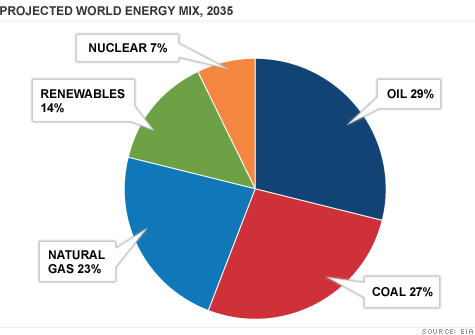
Fossil fuels will continue to be the dominant fuel choice in 2035, the agency predicts, with renewables constituting just 14% to the world’s overall energy consumption.

But that’s a substantial jump from renewable energy consumption in 2008, which stood at 10%. That growth rate makes renewables the fastest growing of all the energy sources, the report said.

The agency noted that most future renewable energy supply will continue to come from wind and hydropower. It did not include biofuels like ethanol as part of its renewable catalog, instead lumping it in with liquid fuels like oil.

EIA does not expect solar power to become a significant energy source by 2035. That runs counter to the opinion of solar power supporters who foresee rapidly declining prices for solar panels in the coming years.

The agency predicts nuclear power will go from about 5% of overall energy consumption in 2008 to about 7% in 2035. The vast majority of new nuclear plants are expected to be built in China. EIA did not factor in how last year’s nuclear disaster in Japan might impact nuclear power plant construction.

Natural gas continues to make up nearly a quarter of the world’s energy consumption, driven by increasing development of shale gas.

EIA projections for natural gas use by 2035 are 8% higher in this year’s report compared to last year’s, largely due to shale gas development.

Natural gas from shale, which is found in a different type of rock than most previous natural gas developments, has grown rapidly in recent years thanks to new drilling and extracting technology.

The technology involves cracking the shale rock with pressurized, water, sand and chemicals — a process knows as hydraulic fracturing, for“fracking” for short.

But the process has many people concerned over its effects on the groundwater, and shale gas development has been put on hold or stopped in some locations.

Despite the concerns, EIA predicts shale gas and other unconventional forms of natural gas will make up three quarters of U.S. natural gas production by 2035, up from about half today. Similar patterns are expected in China and Canada.  To top of page

First Published: September 19, 2011: 3:28 PM ET


Posted in Current News | Comments Off on Global energy use to jump 53%

EPA Delays Greenhouse Gas Regulations, Raising Concerns Over Climate Change And Public Health

Reprinted from the Huff Post Green September 16, 2011

The U.S. Environmental Protection Agency’s announcement yesterday that it will miss a Sept. 30 deadline for issuing new rules on greenhouse gas emissions has sparked an increasingly familiar pair of contrasting reactions: livid criticism and loud cheers.

The agency’s latest postponement comes on the heels of last month’s decision by the Obama administration toput off new ozone standards. And Sept. 30 won’t be the first deadline the EPA has missed for greenhouse gases; a July deadline was also not met.

Experts warn that any further delays in air pollution regulations for power plants could deleteriously affect public health, given the known direct health effects of pollutants such as ozone and black carbon, as well as the indirect dangers of greenhouse gases such as climate change-driven rises in heat stress, infectious disease and extreme weather events.

“For a healthy economy, you have to have healthy people,” Elizabeth Martin Perera, a public health expert with the nonprofit Union of Concerned Scientists Climate and Energy Program, told The Huffington Post.

Of course, environmental concerns are at stake as well. “Every day that climate emissions go up, we’re endangering the planet further. Once in the atmosphere, these emissions are long-lasting,” David Goldston, director of government affairs for the Natural Resources Defense Council, told HuffPost. “So the longer we wait, the greater the likelihood that there will be greater environment and health consequences.”

Under the Clean Air Act, the EPA is required to regulate carbon dioxide and other greenhouse gases — if the agency determines that they pose a danger to human health. EPA experts found that to be the case.

The EPA acknowledges its responsibility of moving forward with the regulations. According to Betsaida Alcantara, a spokesperson for the EPA, greenhouse gas standards are still on their way. She told HuffPost in an email that a new schedule will be announced “soon” and that the agency will consider all information as they “develop smart, cost-effective and protective standards.”

Of course, the “cost” piece remains intensely controversial: Industry figures continue to say new regulations would be economically damaging.

“This announcement, as well as President Obama’s recent request that E.P.A. withdraw the ozone standard, makes one thing clear: not only will E.P.A.’s barrage of regulations cost hundreds of thousands of American jobs, they may cost President Obama his own job, and he knows it all too well,” Senator James Inhofe, an Oklahoma Republican and outspoken climate change skeptic, told The New York Times.

But Mark Jacobson, a greenhouse gas expert at Stanford University, disagrees. “The EPA is well aware that controlling air pollution has a benefit-to-cost ratio of about four to one,” he told HuffPost. “It’s detrimental to delay. It’s costing people more money through taxes and health insurance.”

Not only will climate change bring more unhealthy heat, extreme weather and disease, Jacobsen said, higher temperatures will exacerbate levels of other air pollution such as lung-damaging ozone.

A study published in February by Political Economy Research Institute at the University of Massachusetts Amherst concluded that “new air pollution rules proposed for the electric power sector by the Environmental Protection Agency will provide long-term economic benefits across much of the United States in the form of highly skilled, well paying jobs through infrastructure investment.”

Specifically, researchers found that investments could create an estimated 1.46 million jobs between 2010 and 2015.

And on Wednesday, the Federal Energy Regulatory Commission told congressional Republicans that U.S. power plants are capable of complying with new environmental rules without raising electricity costs or stifling job creation.

Jacobson said there is historical precedent for such optimism: the aftermath of the Clean Air Act Amendments of 1970. “The auto industry complained that they would cost them money, but in fact they just invented the catalytic converter,” he said. “And, as a result of that, not only did the air become cleaner, but sales never went down and the gross national product of the U.S. went up.”

Still others don’t see the postponement as either surprising or important. “We’ve known for a while that they just wouldn’t be able to do this,” said Jeff Holmstead, a former EPA official now at law firm Bracewell & Giuliani. He noted that the group of EPA experts working on this rule are the same ones dealing with a long list of pending coal-fire power plant regulations.

“While greenhouse gas emissions are a sexy subject, it’s not as important as other rules,” he added.

If the EPA’s goal is to shut down old power plants, he suggested that the rule would fall well short given specific limitations under the Clean Air Act. On the other hand, he said that the EPA could win significant greenhouse gas reductions indirectly through a separate set of Clean Air Act regulations, such as regulations focusing on mercury pollution. These pending rules, which have a court-ordered deadline of November 16, would impact the same polluters that emit greenhouse gases.

“We feel it is important that EPA takes all the time it needs to craft this rule because it’s an extremely complex issue, one that is global in nature and can’t be solved within the borders of the United States,” added Pat D. Hemlepp, director of corporate media relations for American Electric Power, in an email to HuffPost.

Such patience is not so easy for everyone. “We’ve just had such an onslaught of attacks in the House,” said Perera. “The ozone decision started a very dangerous trend. We need to see Obama stand strong on this and to give the EPA the backing that it needs.”

 

Posted in Current News | Comments Off on EPA Delays Greenhouse Gas Regulations, Raising Concerns Over Climate Change And Public Health

THE JOBS PLAN THE PRESIDENT MISSED (SD U-T 9-15-11)

The Jobs Plan the President Missed

Reprinted from the San Diego Union Tribune

By John Reaves

President Barack Obama’s jobs plan offers a costly cushion with little hope for lasting change. Extending payroll tax cuts exacerbates underfunded Social Security. Carrying certain state jobs is not sustainable, and extending unemployment benefits likely postpones the inevitable. Limited investing in infrastructure and clean tech may create some new jobs in desirable sectors, but not enough. Regardless, the total cost is nearly $450 billion and Congress is in no mood to approve new spending.

There is a plan, however, that requires no government investment and will create countless jobs while restructuring our economy in several beneficial ways. The plan the president missed would boost jobs across all sectors, nudge everyone to conserve and use energy more efficiently, and trigger a massive investment of private capital into new businesses that see opportunities. I am talking about a revenue-neutral carbon fee combined with a full dividend, or rebate, that is recycled to all households.

Here is the plan: A steadily increasing carbon fee beginning at $15 per ton per year would be assessed by the IRS at the source – the wellhead (e.g., oil), mine (e.g., coal) and port of entry – and placed in a dedicated trust fund. The cost would trickle down and affect choices consumers make. More importantly, it would send a strong, predictable price signal to the market and create vast opportunities for those who make cleaner products and conserve use of fossil fuels. Venture capital would flood into the market without government direction.

It is hard to imagine any sector of our economy that would not find new opportunities and create new jobs. Moreover, investments in clean tech would lead to breakthroughs that further help us solve a handful of serious, intertwined issues (national security; economy; climate change; health; environmental degradation caused by securing and burning fossil fuels).

To protect our imports and exports under the plan, if another country lacked a comparable carbon fee, the Department of Commerce would place a tariff for the difference on the import. That would create a “reverse domino” affect, encouraging other countries to collect the fee themselves, which would propel them to cleaner energy. If an American business were to export a product to a country without an equivalent carbon fee, we would pay such business the difference in fees from the trust fund to stay competitive. We could find the world follows our clean lead.

Here is one of the best parts of the plan: All of the money would be returned equally to all households as a dividend (one share for each adult (up to two) and one-half share for children (up to two) per household). About 60 percent to 70 percent of households would receive dividends that exceed or equal the fees paid. Thus, the plan is progressive. While there have been variations on the theme, such as a Republican proposed reduction of payroll taxes, payments to a broader range of affected people would be more fair and immensely popular. Payments could be made by monthly check, debited to bank accounts, payroll tax offset or credit to tax returns.

We all agree on the benefit of switching to cleaner energy, whether to reduce greenhouse gases, breathe cleaner air, reduce premature deaths and asthma, reduce dependence on foreign oil, increase national security, avoid higher-risk oil and gas explorations, avoid grinding vast landscapes for highly polluting tar sand oil, or to hedge against volatile oil prices as we venture past world peak oil production. We must also remain competitive with China, which is investing billions more than we are in the future of renewables. No doubt, the winner of the clean energy revolution will enjoy world prominence and power.

What may seem remarkable to some is that there is bipartisan support for fee-and-dividend because it would not create fiscal drag, money would stay out of government coffers, and government would not pick winners, as touted by President Ronald Reagan’s secretary of state, George Shultz. The marketplace would decide the winners. Economists and businesses like the plan because it would provide a predictable rise in fees on which investment decisions can be based. Further, research has shown that a dollar invested in clean tech grows twice as many jobs as oil and gas.

The benefits of moving away from fossil fuels are manifold. When people appreciate the scale of positive change that would result from fee-and-dividend, they will finally have real reason for hope.

Reaves is an environmental lawyer and board member of the San Diego-based Citizens Climate Lobby.


Posted in Reaves' Opinions and Letters to the Editor | Comments Off on THE JOBS PLAN THE PRESIDENT MISSED (SD U-T 9-15-11)